
Our Team.
Our team's mission is to teach and educate Slovak/Eastern European Dance Houses with teachers from Slovakia, through workshops for dancers, musicians, and singers

Michal Noga
Lecturer, Founder
Michal Noga is a highly regarded Slovak ethnologist, pedagogist, and virtuoso violinist who has dedicated his career to the contemporary revitalization of Slovak and Carpathian musical folklore. Combining academic rigor with vibrant stage performance, Noga pursued a formal education in ethnology and ethnomusicology, a background that provided him with the methodological tools needed to conduct extensive fieldwork. Rather than treating folklore as a static artifact, he traveled to remote villages to learn directly from elder masters, Romani string bands, and local musicians. Most notably, he personally studied the intricate, authentic regional styles of Eastern Slovakia under the legendary Roma primáš (lead violinist) Jozef "Češľak" Kroka from Zámutov, a mentorship that profoundly shaped his artistry and inspired his moving musical tribute, "Češľakova Ostatná" ("Češľak's Last"). Over the years, Noga expanded his practical mastery by playing with and leading prominent folk ensembles and musical collectives, establishing himself as a vital force within the Táncház (Dance House) movement. As the bandleader of the acclaimed Michal Noga Band (NOGABAND), he channeled these immersive experiences into the 2020 debut album Stopy (Tracks). The album, which seamlessly blends archival snippets with powerful live reconstructions of traditional music, achieved critical international acclaim—entering both the World Music Charts Europe and the Transglobal World Music Chart while earning a prestigious Radio_Head Award in Slovakia.
Beyond the stage, Noga remains fiercely committed to public education and folklore dissemination, viewing teaching as an interactive, community-building practice. Through experiential workshops, he continues to pass down traditional violin styles, regional bowing techniques, and the complex historical contexts of Carpathian folklore to younger generations. By bridging the gap between historical field recordings and active stage performance, Noga ensures that these unique musical idioms remain a living, evolving part of modern cultural identity rather than relics confined to museum archives.

Andrea Levrinc Valčuha
Lecturer, Founder
Andrea Levrinc Valčuha is a Slovak-born musician, educator, and cultural organizer who has dedicated decades to preserving and promoting Slovak and Eastern European folk traditions in the United States. Her deep expertise in folklore was shaped by her extensive performing career in Slovakia, where she was an active member of several prominent folklore ensembles, including Šarišan, Torysa, Vagonár, Karpatčanin, and Letka. Through these acclaimed collectives, she mastered the diverse regional musical styles, vocal traditions, and instrumental techniques of Eastern Slovakia and the broader Carpathian region.In addition to her rich stage experience, Valčuha is a highly accomplished academic. She earned her Master’s degree from the University of Prešov, double-majoring in Music Education and Slovak Language and Literature. This unique combination of deep linguistic knowledge and formal pedagogical training provided her with the perfect foundation for her future work in cultural preservation and education abroad. After moving from Svit, Slovakia, to the United States in the mid-1990s, she quickly became a cornerstone of the New York diaspora folk scene as a skilled violinist and viola-kontra player.
In 1998, she co-founded Pajtáši, a Slovak folk acoustic band that introduces North American audiences to Carpathian musical heritage, frequently collaborating with the New York-based folklore ensemble Limbora. Today, the tradition continues across generations, as Pajtáši often features Andrea's children, rising young primáš's Isabella and Štefan Valčuha. Leveraging her academic background, Valčuha also founded and directs the Little Notes Music School in New Jersey, while partnering with ethnomusicologist Michal Noga to create Hopsa Tábor—an educational camp initiative that brings authentic music and Táncház (Dance House) instruction directly from Slovakia to diaspora families in the United States.
NOGABAND
The Michal Noga Band is a highly regarded Slovak folk music ensemble known for its energetic and top-class interpretations of traditional village music from various regions of Slovakia. Led by the acclaimed virtuoso violinist, composer, and ethnologist Michal Noga, the band meticulously gathers material from extensive fieldwork, old recordings, and master musicians to revive ancient musical expressions for a contemporary audience. Their dedication to preserving and presenting the rich Slovak folk tradition with both authenticity and modern flair has earned them international recognition; their 2020 debut album Stopy, charted in the World Music Chart Europe and Transglobal World Music Chart. The band, which often performs at major folk festivals and dance houses, is a celebrated institution in the Slovak cultural scene. You can explore their work further on their official website.


ĽH Pajtáši
The band Pajtáši is a New York City-based Slovak folk acoustic band dedicated to preserving and performing traditional Slovak, Rusyn, Czech, and Moravian folk music. The group was formed over 25 years ago by Slovak immigrants in the NYC area to serve the local Slovak and other Eastern European communities. They are now made up of two generations and perform at various cultural events and festivals, including the Slovak Heritage Festival in New Jersey and Johnstown Slavic Festival in Pennsylvania, bringing lively entertainment featuring traditional instruments and songs.
Alfred Lincke
Alfréd “Fredo” Lincke is a prominent Slovak contemporary dancer, choreographer, and cultural ethnologist who has dedicated his career to revitalizing traditional Slovak folk dance as a living form of social communication. An alumnus and former faculty member at the Constantine the Philosopher University in Nitra, Lincke bridges academic research with vibrant public engagement. As a driving force behind the immersive House of Traditional Dances (Tanečný dom) initiatives, he breaks down the barrier between performer and spectator by teaching complex regional dances to the general public in lively, social settings. His exceptional technical skill and improvisational mastery have earned him the title of laureate at the prestigious nationwide dance competition Šaffova ostroha.
Beyond his own performances with acclaimed Slovak projects like Partia and Banda, Lincke is a visionary pedagogue and cultural leader. He serves as the director of the children’s folk ensemble Tancovadlo, co-founded the innovative dance workshop festival Rozhýbkosti, and sits on the programming board for the major Myjava International Folklore Festival. Through his specialized training workshops for regional choreographers and his active roles on national folklorism advisory boards, Lincke continues to shape the methodology of folk dance education, ensuring that Slovakia’s rich heritage moves dynamically into the future.


Katarína & Ondrej Galbička
Katarína and Ondrej Galbička are among Slovakia's most respected folk dance educators, choreographers, and cultural ambassadors, recognized for their lifelong dedication to preserving and advancing the country's rich dance heritage. Together, they have devoted their careers to the study, performance, and teaching of authentic Slovak folk traditions, inspiring dancers of all ages through their artistry, scholarship, and innovative educational work. Their shared passion for folklore has made them sought-after instructors at festivals, workshops, and educational programs throughout Slovakia and abroad, where they continue to cultivate a deep appreciation for the living traditions of the Carpathian Basin.
Katarína Galbičková is a graduate of the Academy of Performing Arts in Bratislava, specializing in folk dance pedagogy, and furthered her studies at the Hungarian Dance University in Budapest. She has performed with renowned ensembles including Čečinka, Gymnik, Partia, Szőttes, and the professional dance theatre Ifjú Szivek. In 2016, she received the Gold Award at Slovakia's prestigious Šaffova ostroha national solo folk dance competition. As an educator, choreographer, and artistic leader of the children's folk ensemble Tancovadlo, she has created acclaimed works for Folklórny súbor Živel and has authored or co-authored productions for the Folklore Festival Východná, including Tváre, Enikibeniki, and Tance z kotúčov. She also serves on the faculty of the Hungarian Dance University, where she helps prepare the next generation of folk dance professionals.
Alongside Katarína, Ondrej Galbička has built a distinguished career as a folk dancer, educator, choreographer, and lecturer committed to the preservation and transmission of traditional Slovak dance. He regularly leads workshops, dance houses, and professional development seminars for dancers, teachers, and choreographers, with a particular focus on authentic regional styles and effective folk dance pedagogy. Together, the Galbičkas have become recognized leaders in dance education, presenting at national and international festivals and collaborating on innovative educational initiatives that bridge traditional practice with contemporary teaching methods. Through their performances, choreography, mentorship, and unwavering commitment to cultural preservation, Katarína and Ondrej Galbička continue to shape the future of Slovak folk dance while honoring the traditions that have inspired generations.
Lucia Nogová
Lucia Nogová is an accomplished Slovak folk dancer, pedagogist, and cultural manager deeply embedded in the preservation of traditional Slovak culture. Beginning her artistic journey in youth folklore ensembles, she later honed her craft performing with the prominent university ensemble Technik. Driven by a passion to keep traditional dance relevant and accessible, she went on to co-found the contemporary dance group Kumšt, an ensemble that blends authentic folklore methodology with modern artistic performance. Together with her husband, the prominent folk musician and primáš Michal Noga, she remains a vital pillar of the Slovak traditional art community, dedicated to passing these rich cultural disciplines down to the next generation of dancers.


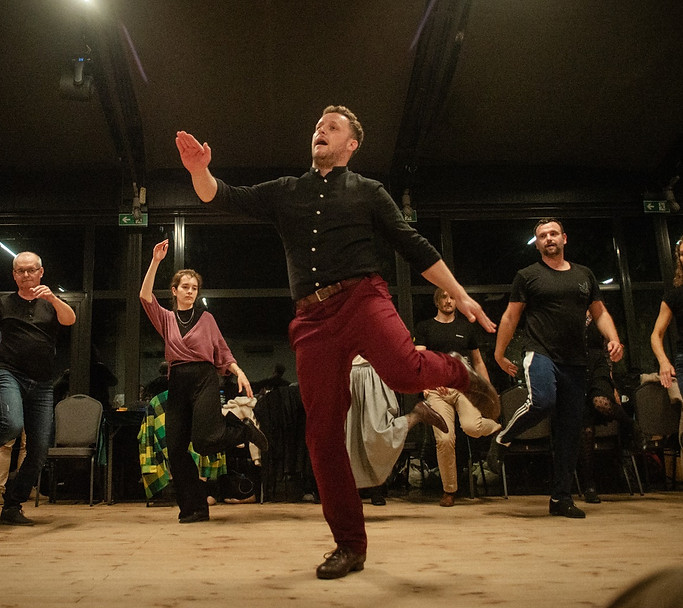

Roman Lewkowicz
Roman Lewkowicz was born in Binghamton, NY. His dancing education began at age 3 with St.John the Baptist Ukrainian Orthodox dancers. From there he began his formal ballet training with the Roberson School of Ballet. From 1991 until 2007, Roman attended intensive dance camps and workshops in Upstate New York.
In 1994-1997, Mr. Lewkowicz was awarded an endowment fund to the Tamburitzans of Duquesne University in Pittsburgh, PA. For over 80 years, the Tamburitzans exist to preserve and celebrate international cultural heritages through artistic performance. From 1998-1999 Roman was contracted as a professional dancer and later commissioned to choreograph a suite of dances for PUĽS in Prešov, SK. His choreography is an active set within the company's repertoire. Mr. Lewkowicz is the only only American-born dancer to be a part of their company since its' creation in 1956. During his time in Slovakia, he also choreographed two dances for Karpaťanin Folk Ensemble (Prešov) and performed in the annual Svidnyk Rusyn-Ukrainian festival with PUL'S in 1999. Roman was also permitted to attend the rehearsals of the Slovak ensemble Šarišan under their pedag of dance Eduard Demčak.
Upon his return to the United States in 1999, Roman created his own semi-professional folk dance ensemble based out of New York City. They performed in festivals, weddings and concerts throughout NY, PA and NJ. Since then, Roman made several return trips to and had the opportunity to choreograph additional dances for PUĽS and work with amateur ensembles like Dubrava (Prešov, SK). In 2003, Roman became the artistic director and choreographer for the Limbora Slovak Folk Dance Ensemble (NYC) until 2007. The Susquehanna Folk Music Society (SFMS) acquired him in 2008 to teach Slovak dance at their annual folk camp. From 2014 until 2019, Roman was commissioned as the instructor and choreographer of the Limboračik Slovak Children's Dance Ensemble in Astoria, Queens. Over the years, Roman has had the distinct pleasure of working with the Pajtaši Slovak Accoustic Band at various festivals in NY, and NJ, as well as at the Slovak Consulate in Washington, DC. Mr. Lewkowicz occasionally performs but continues to teach dance with all his heart.